
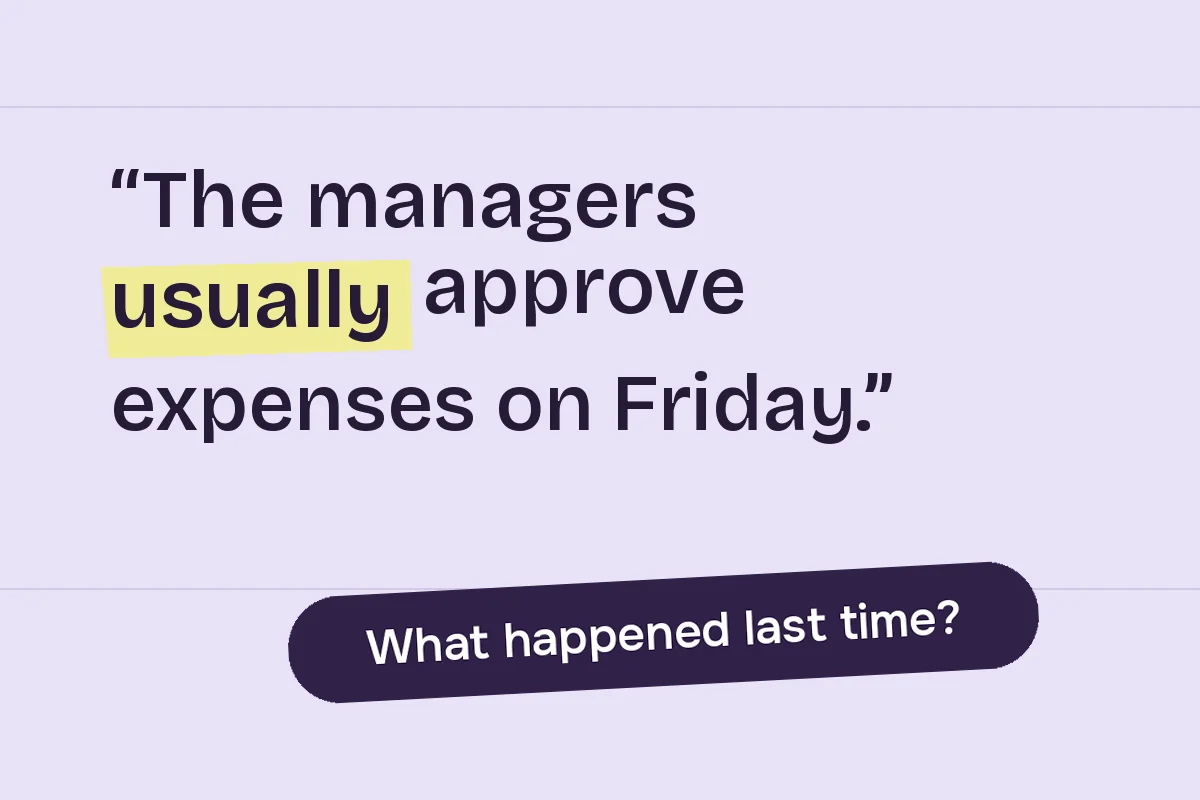
A buyer tells you, “The managers usually approve expenses on Friday.” You could ask how long approvals take and get an average. Or you could follow the little opening they’ve already given you: “What happened the last time it didn’t make Friday?”
Words like “usually” aren’t alarms. They’re invitations to ask whether the exceptions matter. Follow one with curiosity and you may learn more about the work than you would from a list of abstract pain points.
Borrow their word
Qualifiers such as “mostly,” “technically,” and “supposed to” can point to a difference between the written process and the lived one. Repeat the word gently: “You said ‘usually’—when does that change?” That lets the other person decide whether there’s anything worth exploring.
Suppose the buyer replies, “Nothing dramatic. One manager was on leave.” You’ve learned that this exception may need very little attention. Thank them and move on. There’s no prize for turning an ordinary delay into a crisis.

Follow one instance all the way through
A different answer might be, “The hotel charge didn’t have a receipt, so the whole report went back.” Stay with that report for another question: “What did the traveler do next?” You might learn that they had to resubmit four perfectly good receipts along with the missing one.
Continue only as far as the story is useful. Who noticed the missing receipt? How did the traveler find out? What happened after they resubmitted? The point isn’t to interrogate every step; it’s to understand the sequence well enough to avoid inventing the missing parts.
Before switching topics, try a short playback: “One missing receipt sent the entire report back. Is that typical, or was there something unusual about that report?” The second half gives the buyer room to tell you it was a fluke.
Keep the question open
It’s easy to hear a word that fits your hypothesis and turn it into a conclusion. “So approvals are always a bottleneck?” puts a much bigger claim in the buyer’s mouth. “How often does that happen?” or “What happens when it does?” leaves room for a different answer.
Pay attention to what they correct. If they say the delay isn’t the issue but the uncertainty is, follow that distinction. Perhaps the team can tolerate a Friday approval; what causes trouble is not knowing whether it will happen. You won’t know until you ask what the delay means for their work.
Some threads are sensitive. A comment about a manager or a colleague may be difficult to unpack in a group. Ask about the process rather than seeking blame, and let the person decline or suggest a better setting.
Keep the phrase and the evidence
In your notes, put the buyer’s original phrase next to the event they described. Add what you know about frequency and what still needs checking. “Usually Friday; one report returned for a missing receipt; frequency unclear” is more useful than “approvals are broken.”
The expense report that came back
“The managers usually approve expenses on Friday.”
- One instance
- The hotel receipt was missing. The traveler had to send the other four receipts again.
- Still unknown
- How often a whole report comes back because of one receipt.
- Ask next
- “Thinking about the last month, do you remember another report coming back like that?”
At your next discovery call, choose one qualifier and ask for an example. Follow it through, check whether it represents a pattern, and be willing to let it go. A good thread leads you toward a clearer picture, even when the picture isn’t the one you expected.