“Tell me about a time you changed your mind” can sound like an invitation to confess a mistake. But changing course isn’t interesting just because the first idea was wrong. The useful part is how you recognized that your understanding was incomplete and what you did with the new information.
Give the listener enough of the original context to see why the decision made sense, then slow down at the point where something stopped fitting.
Give your first answer a fair hearing
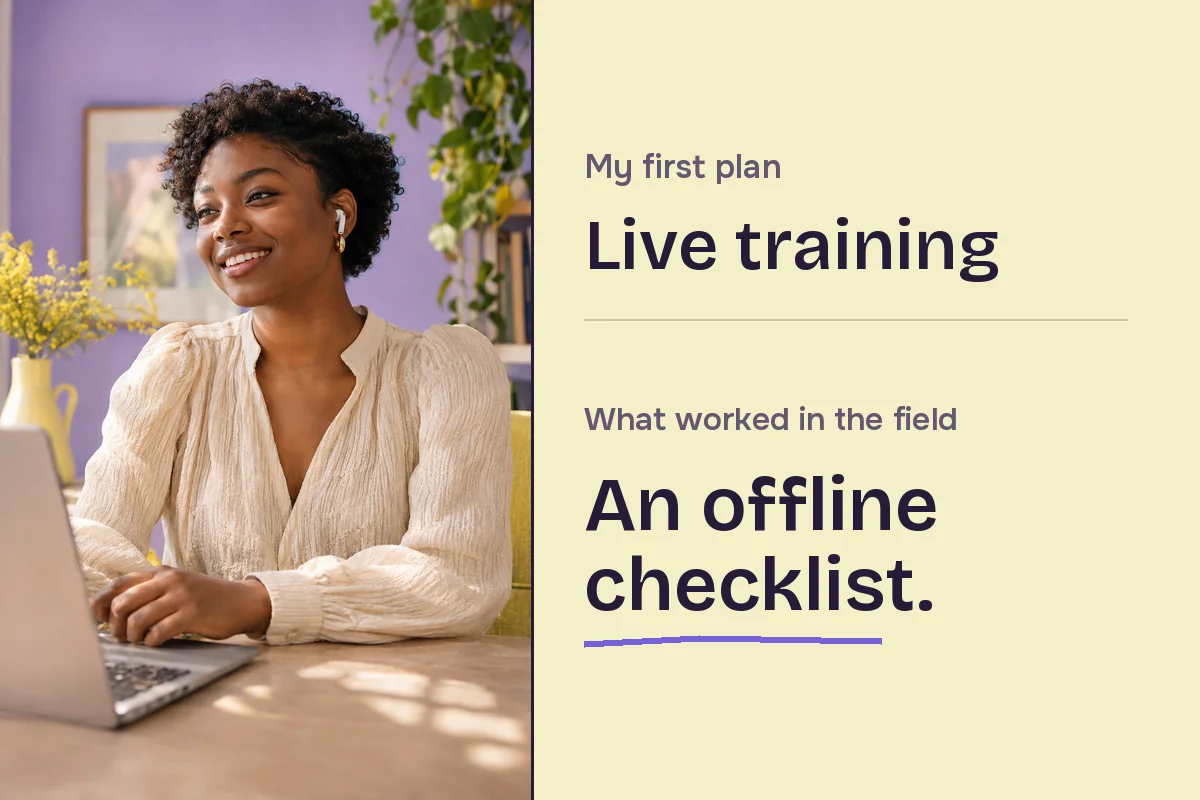
Suppose you chose a live training session for field technicians. The previous release had produced a queue of setup questions, so you wanted people to try the new process with someone available to help. That’s a reasonable response to the information you had.
Explain the goal and the constraint in ordinary language. You might have had a short rollout window, or known that the task was unfamiliar to the group. Avoid making your earlier self look foolish just to make the later decision seem inevitable. The interviewer needs to understand the choice as it appeared at the time.
Locate the turning point
“I listened to feedback” leaves out the part that makes the story yours. What did you hear, see, or test? What did it challenge?
Imagine two technicians complete the exercise during training. The next day, working through an installation with poor reception, they can’t find the instructions. The original plan supported the moment of learning, but didn’t give them a reliable reference when they needed it later.
I’d planned for the moment people learned the task. I also needed to plan for the moment they forgot a step.
That distinction is more revealing than “training didn’t work.” The session may have been useful; it just wasn’t the whole answer. If a colleague raised the issue, say so. Explain how you checked your interpretation rather than presenting their observation as your own discovery.

Show the change and its cost
Describe the revised approach at the same level of detail. You might keep the live walkthrough and make a one-page offline checklist for the van. Who would help check that the steps are accurate? How would you find out whether someone can use it without the trainer nearby?
A change can bring a tradeoff. A checklist takes time to maintain; a shorter session may leave less room for questions. Naming that cost shows how you weighed the decision. It also keeps the story from becoming a tidy before-and-after in which one observation magically settles everything.
If the revised plan was never tested, say that. If it helped in one situation but not another, describe the boundary. An interviewer can ask about an incomplete outcome; they can’t learn much from certainty you didn’t have.
You might also have had to persuade someone to make the change. Explain the conversation accurately: what concern did they raise, and what information helped the group decide? You don’t need to turn a disagreement into a dramatic confrontation. A practical question about maintenance can be just as useful to the story.
Keep the lesson small enough to use
End with a practice you could actually repeat. “Listen more” sounds agreeable, but it doesn’t tell anyone what you’d do next. “I’d watch someone try the task again a day later, using only what we left them” gives the lesson a shape.
Training for an installation with no signal
- My first call
- I chose a live walkthrough so the technicians could ask setup questions as they worked.
- What changed my mind
- Both technicians finished the exercise. The next day they got stuck on site because the instructions needed a connection.
- What I’d change
- Keep the walkthrough. Put a one-page checklist in the van and have a technician check the order of the steps.
- How I’d check it
- Ask someone to try the next installation offline with the sheet. Until then, I can explain the change, but I can’t claim it worked.
Before an interview, jot down the first decision, the evidence that challenged it, the change, and what remains uncertain. You don’t have to recite those notes in order. They’re there to help you answer naturally when someone asks, “What made you reconsider?”